

Introduction – Why Steering Knob Smoothness Matters for Driving Comfort
Smooth steering is not just a nice extra; it is a core part of real driving comfort. When you turn a steering knob and it glides effortlessly, you immediately feel more in control and relaxed. Behind that effortless motion is often a carefully designed precision bearing that quietly manages friction and load.
As vehicles get heavier and routes more demanding, steering knob smoothness becomes even more important for everyday drivers and professionals. Because each small turn adds up over hours, poor bearing design can turn simple maneuvers into tiring work. Therefore, understanding how precision bearings affect steering feel is the first step toward improving long-term driving comfort.
From Effort to Ease – How Drivers Feel Steering Friction
Drivers usually notice friction only when something feels wrong. During slow parking maneuvers, every extra bit of resistance in the steering knob forces the hand to push harder. Over time, this repeated effort turns small corrections, like lining up with a curb, into a subtle source of stress.
In tight U-turns, drivers often twist the knob quickly, and extra friction shows up as jerky, uneven motion. However, when the steering knob rotates smoothly on a precision bearing, the driver can modulate steering input with much finer control. This smoother response not only feels better, but it also builds confidence in tight spaces and busy yards.
At low speeds, many drivers rely on rapid, repeated knob movements to position large vehicles precisely. Because friction can spike unpredictably in cheap mechanisms, the steering response may lag, jump, or even feel sticky. As a result, drivers must constantly compensate, which increases both physical effort and mental workload.
The Link Between Steering Knob Smoothness and Driver Fatigue
Steering may look simple from the outside, yet it engages many small muscles in the hands, wrists, and shoulders. When a steering knob fights back with friction, each correction adds extra load to these joints. Over long shifts, that additional resistance can translate into soreness, stiffness, and even reduced grip strength.
Fleet and professional drivers feel this effect most clearly, because they repeat low-speed maneuvers hundreds of times per week. Moreover, operators of delivery vans, refuse trucks, tractors, and construction equipment often work in confined yards where constant steering is required. If their steering knobs rotate smoothly, the same tasks demand less force, so fatigue builds far more slowly.
Older drivers and people with limited hand strength are even more sensitive to steering knob smoothness. Because their muscles reach fatigue sooner, any extra resistance can make vehicle control painful or discourage independent driving. Conversely, when the knob glides with minimal effort, these drivers can maintain control with less strain and more confidence.
Where Precision Bearings Come In
From the outside, two steering knobs may look almost identical, yet the internal engineering can be very different. In many low-cost designs, the knob rotates on simple bushings or rough surfaces that create uneven friction. However, a knob built around a true precision bearing uses hardened raceways and finely finished rolling elements to keep motion consistent.
Because the precision bearing controls clearances tightly, the knob can spin freely without wobble or sudden changes in resistance. This stability matters not only for comfort, but also for predictable steering response when the vehicle is fully loaded. As a result, drivers experience a smooth, linear feel from hand movement to wheel angle, which supports precise vehicle placement.
Precision bearings also maintain performance over time, even as dust, vibration, and temperature swings challenge the steering system. Cheaper mechanisms may feel acceptable on day one, yet they often degrade quickly, so friction and noise creep in. Therefore, choosing a steering knob built around high-quality precision bearings is one of the most effective ways to protect long-term driving comfort.
Section Summary
Smooth steering knob operation turns demanding maneuvers, like parking and tight U-turns, into easier and more comfortable movements. Because friction directly shapes how much effort drivers must apply, it also influences fatigue, confidence, and overall driving comfort. Professional, elderly, and accessibility-focused drivers feel these differences most strongly, since they spend more time or energy at the wheel. Ultimately, the precision bearing hidden inside the steering knob is what transforms raw hand force into smooth control that lasts.
What Is a Precision Bearing in a Steering Knob?
A precision bearing is the hidden heart of a smooth steering knob. Because it controls how the knob rotates under load, it has a direct impact on steering knob smoothness and overall driving comfort. Instead of letting the knob rub on rough plastic surfaces, the precision bearing uses engineered rolling elements to manage friction in a controlled way.
When this small component is designed and manufactured accurately, the knob turns freely, without wobble or grinding. As a result, every steering input feels lighter, more predictable, and easier to repeat during long driving days.
Basic Bearing Anatomy – Races, Balls, and Lubrication
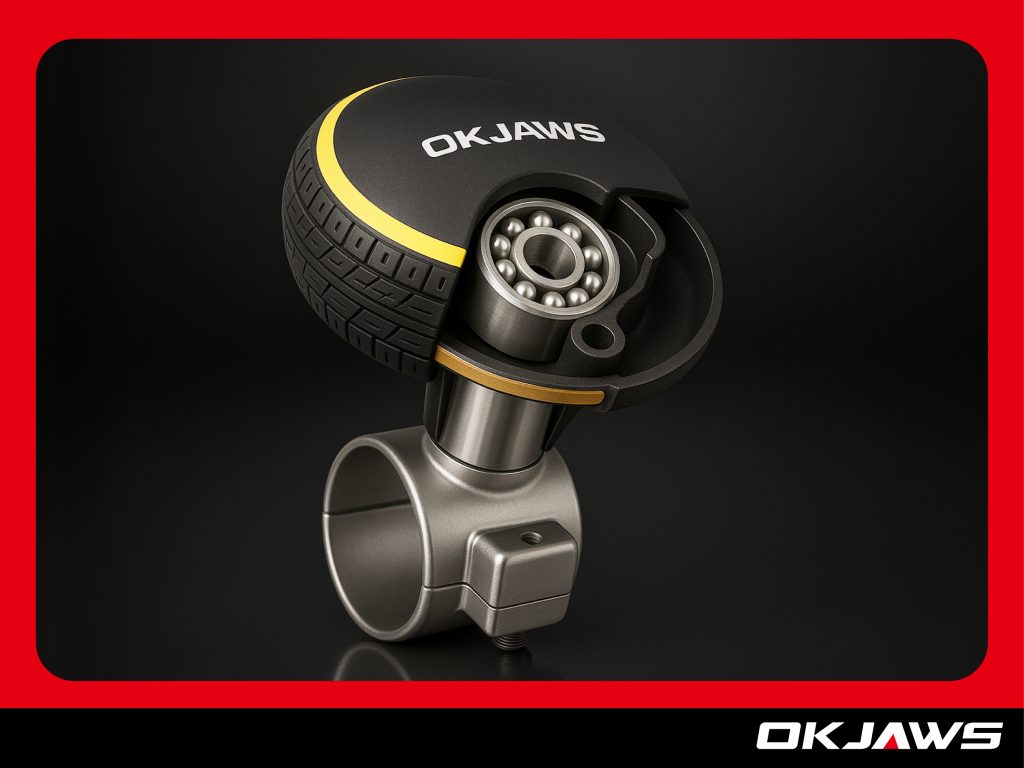
At its core, a typical ball-type precision bearing is built from three main elements. First, there is an inner race and an outer race, which are ring-shaped tracks made from hardened steel. Between these races, a row of small steel balls rolls in a controlled path, usually guided by a cage or retainer.
Because the balls roll instead of sliding, they dramatically reduce friction between the inner and outer races. This rolling contact is what allows the steering knob to rotate smoothly around its mounting point. In a well-made precision bearing, the raceways are carefully shaped so the balls share the load evenly and do not dig into the metal.
Lubrication is the final key piece. A thin film of grease or oil sits between the balls and raceways, which further reduces friction and wear. In a sealed steering knob bearing, this lubricant is kept inside the bearing for long life, while contaminants are kept out. Therefore, even after years of use, the knob can still turn with light, controlled resistance that supports steering knob smoothness and stable driving comfort.
Precision vs. Generic Bearings
At a glance, many bearings look similar, yet the difference in performance can be huge. Generic bearings often have looser tolerances, meaning the balls, raceways, and clearances are not tightly controlled. As a result, the knob may wobble, feel rough, or change resistance as it turns.
Precision bearings, however, are manufactured to strict tolerance classes. The balls are more perfectly round, the raceways are finely ground, and the clearances are carefully set. Because of this, the movement stays consistent in every direction, even when the steering knob is under repeated loads and vibrations.
Surface finish is another important factor. In a precision bearing, the contact surfaces are smooth and polished, which lowers friction and reduces noise. Generic parts usually have rougher surfaces, so the knob can feel gritty or develop noise as it wears. Therefore, “precision” is not just a marketing term; it describes the tighter control that directly improves steering knob smoothness and long-term durability.
Bearings Used in Steering Knobs
Steering knobs typically use compact radial ball bearings that can handle both radial and light axial loads. These bearings are designed to fit inside the knob body and around the mounting shaft or screw. Because space on the steering wheel is limited, the bearing must be slim yet strong enough to support repeated forces.
Most quality steering knobs use sealed precision bearings. The seals keep dust, moisture, and small particles away from the raceways and lubrication. Consequently, the bearing maintains its smooth feel even in harsh environments, such as delivery trucks, agricultural equipment, or construction machinery.
Open or poorly sealed bearings may work at first, but they usually degrade faster as contaminants enter the contact area. Over time, this leads to increased friction, rough rotation, and even early failure. By choosing compact, sealed precision bearings for steering knobs, designers protect steering knob smoothness and give drivers a more consistent level of driving comfort throughout the product’s life.
Section Summary
A precision bearing in a steering knob is a compact assembly of races, balls, and lubrication that manages motion with controlled, low friction. Because it is built to tighter tolerances and finer surface finishes than generic bearings, it keeps the knob stable, smooth, and predictable. Drivers benefit from easier rotation, less wobble, and fewer changes in resistance, especially under daily use. Ultimately, this hidden precision bearing is what turns a simple steering accessory into a long-lasting tool for better steering knob smoothness and dependable driving comfort.
Inside the Mechanism – How Precision Bearings Create Smooth Steering
Inside every good steering knob, a precise mechanical chain converts your hand force into smooth, controlled wheel rotation. Because the precision bearing sits at the center of this chain, it decides how light, stable, and predictable each movement feels. When that bearing is well designed, steering knob smoothness improves immediately, and overall driving comfort follows.
Converting Hand Force into Rotational Motion
When you grab the steering knob, the motion starts with your hand and fingers. As you push or pull, your grip transfers force into the knob body, which is usually made from a rigid material such as metal or reinforced plastic. Then, this knob body passes the load directly into the inner race of the precision bearing.
From there, the inner race rotates relative to the outer race, which is fixed to the mounting bracket on the steering wheel. Because the bearing sits between the rotating knob and the fixed clamp, it allows the knob to spin freely while the wheel itself turns. Finally, the clamp transmits the motion into the steering wheel rim, which then adjusts the vehicle’s direction.
Along this path, friction losses can occur at several points. For example, if the knob body flexes, some of your effort is wasted in bending rather than rotation. If the bearing is poorly made, friction appears at the ball–raceway contact, causing drag and vibration. Therefore, high-quality precision bearings are crucial for minimizing these losses and preserving a clean, direct feel from your hand to the steering wheel.
Contact Surfaces and Friction Reduction
Inside the bearing, contact surfaces determine how easily things move. In low-quality designs, parts may slide against each other, which creates high friction and heat. However, in a precision ball bearing, most of the motion happens as rolling friction, where hardened balls roll between smooth raceways.
Rolling friction is much lower than sliding friction, so the steering knob requires less effort to turn. As a result, the knob responds more quickly and with fewer sudden changes in resistance. This stability is what drivers recognize as true steering knob smoothness, especially during slow, controlled maneuvers.
Moreover, precisely finished contact surfaces help prevent “grinding” or “sticking” sensations. When the balls and raceways are accurately shaped and polished, they share the load evenly and avoid sharp pressure points. Consequently, the knob feels consistent throughout a full rotation instead of catching in certain positions, which improves both comfort and control.
Lubrication, Seals, and Long-Term Smoothness
Even the best metal surfaces need lubrication to stay smooth over time. Inside a precision bearing, a carefully selected grease forms a thin film between the balls and raceways. Because this film separates the metal surfaces, it reduces wear, dampens noise, and keeps friction low. In addition, the grease helps protect against corrosion, which would otherwise roughen the contact surfaces.
Seals play an equally important role. They surround the bearing and keep dust, moisture, and small particles out of the rolling elements. Without proper sealing, contaminants can mix with the grease, turning it into an abrasive paste that accelerates wear. Eventually, this leads to a rough feel, increased resistance, and a noticeable drop in steering knob smoothness.
For fleets and heavy users, this protection is critical. Their steering knobs may rotate thousands of times per week in harsh environments such as loading docks, farms, or construction sites. Because sealed precision bearings hold their lubrication and block contaminants, they maintain smooth rotation much longer. Therefore, drivers enjoy stable driving comfort over months and years, not just in the first few days after installation.
Section Summary
In a steering knob, your hand force travels through the knob body, into the precision bearing, and then into the steering wheel, with each interface shaping how smooth the movement feels. When rolling contact replaces sliding friction, and when contact surfaces are accurately finished, the bearing converts effort into clean, low-resistance rotation. Grease and seals then protect this performance by keeping the internal surfaces lubricated and free from contaminants, even under heavy use. Altogether, thoughtful precision bearing design is what keeps steering knob smoothness consistent over time and turns everyday steering into a more comfortable, controlled experience.
Engineering Factors That Affect Steering Knob Smoothness
Even with a high-quality precision bearing, steering knob smoothness still depends on how the entire assembly is engineered. Because every component interacts with the bearing, design decisions about tolerances, materials, and mounting all change how the knob feels in the driver’s hand. When these factors are handled correctly, the knob rotates lightly, stays stable, and delivers consistent driving comfort over its lifetime.
Bearing Tolerance Grades and Runout
Every precision bearing is produced to a specific tolerance class that controls how round the balls are, how accurate the raceways are, and how much internal clearance exists. When these tolerances are tight, the inner and outer races remain well centered, so the steering knob follows a clean, predictable rotational path. As a result, the driver feels smooth, uniform resistance instead of wobble or pulsing.
If tolerances are too loose, extra clearance can lead to radial runout, where the knob appears to “wander” as it turns. This runout often shows up as slight vibration, noise, or an uneven feel during rotation. Moreover, any misalignment between the bearing and housing can overload one side of the raceway, which causes localized wear and makes the knob rough in certain positions. Therefore, choosing the right tolerance grade and controlling runout are essential to preserving steering knob smoothness.
Materials – From Raceways to Housing
Material quality has a direct impact on how a steering knob feels over time. Precision bearings typically use high-grade bearing steel for the races and balls, since this material offers high hardness, good fatigue strength, and an excellent surface finish. Because the contact surfaces resist deformation, the rolling motion stays accurate and quiet, which supports a smooth steering feel.
By contrast, inferior materials can dent or wear more quickly, and those small defects are transmitted straight to the driver’s hand as roughness or micro-vibration. In addition, the knob housing must be stiff enough to hold the bearing in proper alignment. A strong metal body, such as a zinc alloy housing, keeps the bearing seated firmly and maintains a solid connection to the steering wheel. However, a softer or more flexible plastic structure can flex under load, slightly tilting the bearing and introducing wobble. Consequently, the combination of robust bearing steel and a rigid housing is crucial for stable, precise steering knob smoothness.
Mounting, Clamping, and Torque Settings
Even the best bearing and housing can feel poor if the knob is not installed correctly. The clamp must match the steering wheel rim and sit flat so that the bracket does not twist or distort the bearing position. When the mounting surfaces are properly aligned, the bearing can rotate around its true center, and the knob feels naturally balanced.
Torque settings on the mounting screws also play an important role. If the clamp is over-tightened, it can squeeze the bearing races and create excessive preload, which raises friction and makes the knob feel heavy or sticky. If the screws are too loose, the knob may shift or rattle, and that extra movement is perceived as play or instability. Therefore, following the recommended tightening sequence and torque values ensures that the bearing is supported firmly but not crushed, so the designed smoothness is maintained.
Section Summary
Steering knob smoothness is the result of several tightly linked engineering choices rather than the bearing alone. Accurate tolerance grades and low runout keep the knob rotating on a true centerline, with minimal wobble or vibration. High-quality materials in both the bearing and the housing preserve alignment and surface finish, so the rolling motion stays clean and consistent. Proper mounting, clamping, and torque settings then allow the bearing to work as intended, without added friction or play. Together, these factors transform precise engineering into a steering knob that feels light, stable, and comfortable every time the driver turns the wheel.
From Smooth Rotation to Real Driving Comfort
When a steering knob turns smoothly, the benefit is not just a nicer “feel” in the hand; it changes how the whole upper body works while driving. Because the knob rotates easily on a precision bearing, every steering correction demands less strength, less grip, and less joint movement. Over a full day behind the wheel, these small savings add up, so smoother mechanics turn directly into better driving comfort, lower fatigue, and more controlled, confident maneuvers.
Ergonomics – Load on Hands, Wrists, and Shoulders
From an ergonomic point of view, the steering knob acts like a lever between the driver and the steering system. When the knob rotates freely, the hand can stay more relaxed, and the driver uses less pinch force and less wrist torque on each turn. Consequently, the muscles and tendons in the fingers, wrist, and forearm do not need to fight against friction inside the knob.
For long-haul and delivery drivers, this difference is especially important. They often perform hundreds of low-speed turns every shift: backing into docks, navigating tight yards, or weaving through city streets. If the steering knob drags, each maneuver becomes a small workout. However, when a precision bearing keeps the motion smooth and predictable, the cumulative load on the hands, wrists, and shoulders drops significantly, which helps reduce soreness and end-of-day fatigue.
Comfort vs. Control – Why Smooth Doesn’t Mean Slippery
Sometimes people worry that “too smooth” might mean “too slippery,” yet those are not the same thing. A well-designed steering knob combines low internal friction with a secure external grip. The precision bearing reduces resistance inside the knob so it turns easily, while the outer surface and knob shape provide enough friction for the driver’s hand to hold firmly.
Because of this balance, smooth rotation does not cause the hand to slide off the knob. Instead, it allows the driver to apply very small, precise inputs without sudden jumps in resistance. Properly tuned precision bearings also avoid free-spinning or uncontrolled motion; the knob still has a gentle, stable feel rather than spinning wildly. As a result, drivers enjoy both comfort and control, with predictable feedback at every steering angle.
Safety and Reaction Time
Steering control plays a key role in overall driving safety. In tight situations—such as avoiding an obstacle in a yard, maneuvering around pedestrians in a loading area, or correcting a trailer’s path—a driver must adjust the wheel quickly yet smoothly. When the steering knob turns cleanly on a precision bearing, those adjustments can be done with less effort and more accuracy, which supports faster, more controlled reactions.
Safety guidance from road-safety organizations consistently emphasizes maintaining good control of the steering system and minimizing driver fatigue, because tired or strained drivers react more slowly and less precisely. Smooth-operating controls help here by reducing physical overload, especially for professional drivers who steer for many hours. In this way, the same engineering choices that improve steering knob smoothness—tolerances, bearing quality, and ergonomic design—also contribute indirectly to safer, more confident maneuvers on the road.
Section Summary
Smooth rotation in a steering knob reduces the load on hands, wrists, and shoulders, so drivers use less effort and experience less fatigue, particularly on long shifts and frequent low-speed maneuvers. At the same time, a well-designed knob keeps a secure grip surface, so low internal friction improves comfort without sacrificing control. Because precise, low-effort steering inputs support quicker and more accurate reactions, these engineering choices around precision bearings and knob design ultimately enhance driving comfort, reduce strain, and help drivers perform safer, more controlled maneuvers in real traffic and work environments.
Okjaws Engineering – Precision Bearings Built for Real-World Use
Okjaws doesn’t treat a steering knob as a simple accessory; it is engineered as a professional control interface between driver and vehicle. Because the internal precision bearing, zinc alloy structure, and screw-secured mounting all work as one system, the result is reliable steering knob smoothness in real, everyday use. As a result, professional drivers and fleets can count on consistent driving comfort instead of “day one only” performance.
40+ Years of Steering Knob Manufacturing Expertise
For more than four decades, Okjaws has focused on steering wheel knobs and related components rather than spreading attention across unrelated products. Over this long period, the company has refined the details that most drivers never see, such as bearing selection, housing geometry, and clamping design. Therefore, the feel of each knob is backed by many years of field feedback from trucks, agricultural machines, construction vehicles, and everyday road cars.
Because OEMs and fleet operators care about consistency as much as comfort, Okjaws structures its production around repeatable quality. Batch-to-batch performance is tightly controlled so that a knob installed in one vehicle feels and lasts like the knob installed in the next. This reliability helps build trust with distributors and professional users who cannot afford unexpected changes in steering feel or durability.
Zinc Alloy Base and Precision Bearing Design
At the core of an Okjaws steering knob is a rigid zinc alloy base that supports the precision bearing. The zinc alloy housing holds the bearing in firm alignment, so loads pass straight from the driver’s hand to the wheel without twisting or flexing. Because the structure stays stable under load, the precision bearing can do its job properly and deliver smooth, even rotation.
Generic plastic knobs often rely on softer materials that can flex or creep over time. When the housing bends, the bearing may tilt slightly, which adds friction and wobble and reduces steering knob smoothness. In contrast, the stiffer zinc alloy construction used by Okjaws resists deformation, keeps the bearing centered, and supports long-term driving comfort even in heavy-duty applications.
Screw-Secured, Anti-Wobble Structure
Okjaws steering knobs use a screw-secured design that locks the assembly to the steering wheel rim with stable, controlled pressure. The clamp and screws are arranged so that the knob grips the wheel firmly without distorting the bearing seat. Because the load path is well supported, the knob resists wobble, play, and loosening over time.
As the vehicle vibrates and the wheel is turned thousands of times, cheaper clamps can shift slightly, which drivers feel as side-to-side movement or rattling. Okjaws addresses this with a robust bracket layout, defined screw positions, and torque-friendly hardware. Consequently, the precision bearing remains properly aligned, and the steering knob keeps its smooth, predictable rotation instead of degrading after a short period of use.
Customization for OEMs, Distributors, and Fleets
Okjaws also designs its steering knobs with customization in mind for OEMs, distributors, and large fleets. Branding options such as custom logos, engraved badges, and color-matched finishes allow the knob to align with a vehicle maker’s identity or a fleet’s visual standards. In addition, different knob shapes, surface textures, and bearing configurations can be tailored to specific vehicle types and use cases.
Distributors and fleet managers can work with Okjaws to select models optimized for particular segments, such as delivery trucks, agricultural machines, forklifts, or passenger vehicles. Internal product codes and catalog structure make it easy to standardize on a small set of steering knobs that still meet varied ergonomic and branding needs. You can direct readers to the Okjaws product catalog or spinner wheel knob lineup via an internal link so they can explore the full range of precision bearing steering knobs in detail.
Section Summary
Okjaws combines decades of focused steering knob expertise with a zinc alloy base, precision bearing core, and screw-secured, anti-wobble mounting system to deliver durable steering knob smoothness in real-world service. The rigid housing keeps the bearing aligned, while the secure clamp preserves a consistent feel even after long periods of use. At the same time, flexible customization options let OEMs, distributors, and fleets match performance with branding and vehicle-specific needs. Altogether, these engineering and design choices allow Okjaws steering knobs to turn precise bearing science into reliable driving comfort for professional users.
Quality Control and Testing of Precision Bearings in Steering Knobs
When Okjaws designs a steering knob, the job is not finished until every precision bearing passes strict testing. Because even tiny deviations can change steering knob smoothness, each batch moves through a clear quality control flow. As a result, drivers and fleets receive knobs that feel consistent from the first turn and keep supporting driving comfort over time.
Dimensional Inspection and Bearing Tolerance Checks
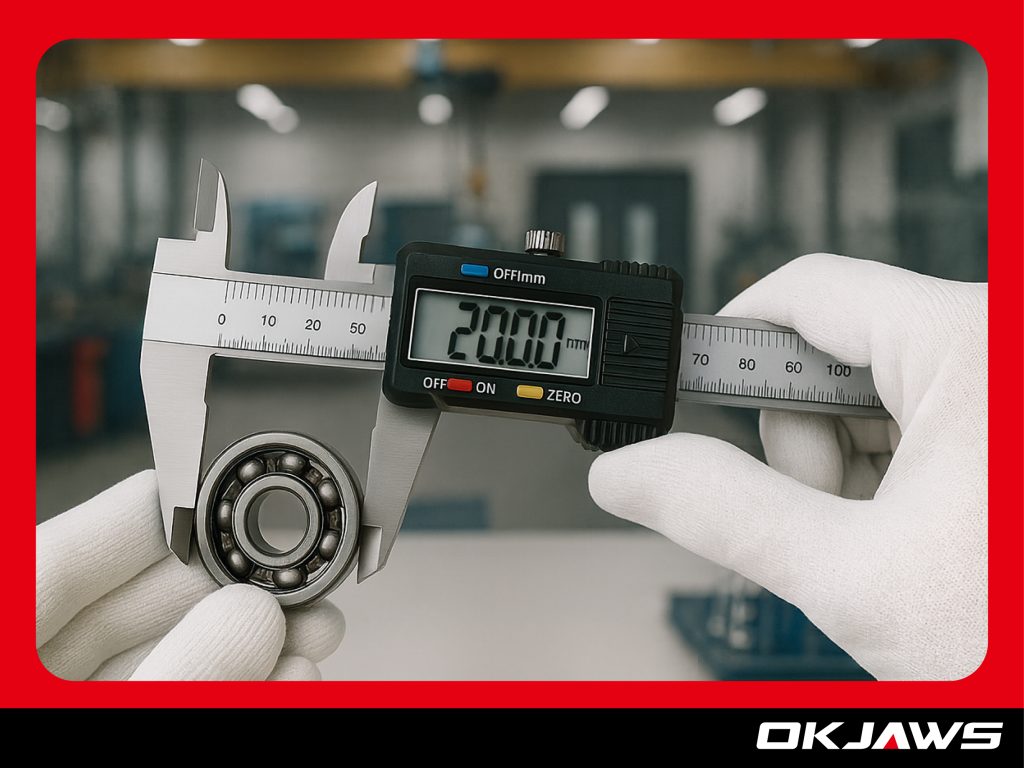
Quality control begins with dimensional inspection of the precision bearing and related components. Technicians check critical sizes such as inner diameter, outer diameter, and width to ensure each part matches the drawing. Because roundness and concentricity are equally important, they also verify that the races and bore stay centered as the bearing rotates.
Moreover, internal clearance is measured to confirm that the balls have enough space to roll, but not so much that wobble appears. If any unit falls outside the specified tolerance window, it is rejected or isolated for further review. Therefore, only bearings that meet strict dimensional and tolerance criteria move forward into Okjaws steering knob assemblies, which directly protects steering knob smoothness.
Torque and Smoothness Testing
After dimensional checks, torque and smoothness tests reveal how the bearing actually feels in motion. Starting torque is measured to see how much force is needed to begin rotation, while running torque shows the effort required to keep the knob turning. Because precision bearings should feel light but controlled, both values must fall within a defined range.
In addition, test rigs can simulate real steering maneuvers by rotating the knob back and forth under load. Engineers watch for irregular torque spikes or “dead spots,” which would later show up as sticking or uneven feel in the vehicle. When a batch passes these torque and smoothness tests, Okjaws can be confident that the precision bearing will support predictable steering knob smoothness in daily driving.
Durability, Vibration, and Corrosion Tests
However, steering knobs must stay smooth long after they leave the factory, so durability testing is essential. Long-cycle rotation tests run the bearing through many thousands of turns to see how wear, lubrication, and contact stresses evolve. In many cases, these follow principles similar to rolling bearing life calculations described in international standards, such as ISO bearing life methods.
Vibration tests then expose the assembled knob and clamp to repeated shocks, which mimic real-world road and chassis inputs. If any looseness, noise, or loss of alignment appears, the design or process is reviewed and improved. Meanwhile, corrosion-related tests such as salt spray or humidity exposure check that external metal parts and finishes resist rust in harsh conditions, often referencing methods like ISO 9227. Because these tests are structured and repeatable, they help ensure that steering knob smoothness and driving comfort remain stable over the product’s service life.
Compliance with Automotive Industry Standards
To meet OEM and fleet expectations, Okjaws aligns its quality system with automotive-grade requirements. Many automotive suppliers use frameworks based on IATF 16949 and ISO 9001, which define how processes, traceability, and continual improvement must be managed. Consequently, every precision bearing and steering knob can be linked back to its production lot, inspection data, and test records.
Because OEMs and large fleets audit suppliers regularly, this structured system is more than paperwork. It proves that torque tests, dimensional checks, and durability trials are performed consistently, not just occasionally. Therefore, when a customer specifies an Okjaws knob, they can expect the same steering knob smoothness and performance from unit to unit, across different batches and markets.
Section Summary
Through dimensional inspection, tolerance and concentricity checks, and detailed torque testing, Okjaws verifies that each precision bearing delivers the intended steering feel. Durability, vibration, and corrosion-related tests then confirm that this smooth rotation survives long-term use and harsh conditions, guided by proven international standards. In parallel, compliance with automotive quality frameworks ensures that these tests are applied consistently and traceably. Altogether, this structured quality control system helps every Okjaws steering knob provide reliable steering knob smoothness and stable driving comfort throughout its lifetime.
Use Cases – Where Precision Steering Knobs Make the Biggest Difference
Precision steering knobs with a well-designed precision bearing show their benefits most clearly in demanding, real-world driving. In these situations, steering knob smoothness has a direct effect on driving comfort, especially when drivers repeat the same maneuvers all day. As a result, different user groups feel the advantages in slightly different ways, from reduced fatigue to better control in tight spaces.
Commercial Fleets and Delivery Vehicles
Fleet and delivery drivers spend much of their day steering at low speed in tight urban routes. They back into docks, squeeze into alleyways, and turn through crowded yards over and over again. Consequently, every extra bit of steering effort adds to muscle load and end-of-day fatigue.
Research shows that professional truck drivers face a high rate of musculoskeletal disorders, with one recent study reporting an overall prevalence of about 62%. In addition, reviews of professional drivers highlight frequent pain in the back, neck, shoulders, and hips due to repetitive postures and control loads. Therefore, even small reductions in steering effort can meaningfully support long-term comfort and productivity.
With a precision bearing steering knob from Okjaws, the wheel can be turned smoothly using one hand during these repeated low-speed maneuvers. Because steering knob smoothness reduces friction at the hand interface, drivers use less grip strength and smaller arm movements for each turn. As a result, fleets can help cut cumulative strain across many stops while keeping vehicles easy to position near loading bays and curbs.
Agricultural, Construction, and Specialty Vehicles
Operators of tractors, loaders, and other off-road machines often work at low speeds with very large steering angles. They may turn the wheel repeatedly while aligning a bucket, following crop rows, or maneuvering around obstacles on site. Therefore, steering comfort becomes a key factor in how tiring a long field or job-site day feels.
In heavy equipment, steering forces can remain noticeable even with power assistance. However, a knob that runs on a precision bearing converts that heavy feel into a smoother, more manageable motion at the driver’s hand. Because the knob rotates freely without wobble, the operator can make fine corrections while watching attachments or implements instead of wrestling the wheel.
Okjaws can configure precision bearing steering knobs for agricultural and construction environments, where robustness and control matter as much as comfort. As a result, operators keep better command of large equipment in slow, heavy maneuvering, while steering knob smoothness helps reduce fatigue across long shifts in the field or on site.
Accessibility and Adaptive Driving Solutions
For many drivers with limited strength, range of motion, or hand dexterity, a steering knob is not just convenient; it is essential. Adaptive driving providers frequently recommend steering wheel spinner knobs so drivers can steer with one hand while operating hand controls or other aids. Consequently, the internal precision bearing becomes critical for both comfort and safety.
A smooth, predictable knob allows drivers with disabilities to control the steering wheel using smaller, more precise movements. Because the knob rotates easily, they do not need to fight internal friction or sudden changes in resistance. At the same time, general accessibility guidance from organizations such as the U.S. Access Board (https://www.access-board.gov/) emphasizes the importance of well-designed interfaces that support independent use by people with disabilities.
Okjaws precision bearing steering knobs can be integrated into adaptive driving packages, matching grip shapes and finishes to individual needs. As a result, drivers gain a steering aid that feels stable, controllable, and comfortable, which helps support independence and confidence on every trip.
Everyday Drivers Seeking Extra Comfort
Not every use case involves a commercial fleet or adaptive controls. Many everyday drivers simply want steering to feel easier when parking a larger vehicle or navigating tight city streets. In these situations, a precision bearing steering knob can offer a simple comfort upgrade.
RVs, vans, and larger SUVs often require bigger steering inputs during low-speed maneuvers. However, a smooth, compact knob lets the driver spin the wheel more quickly with one hand while maintaining a secure grip. Because the knob’s precision bearing reduces internal friction, drivers experience lighter, more controlled motion without the wheel feeling loose or unpredictable.
Okjaws can supply steering knobs tuned for these everyday vehicles, with finishes and designs that match interior styling. As a result, daily commuting, weekend travel, and trailer backing all feel more relaxed, while steering knob smoothness adds a subtle but noticeable boost to overall driving comfort.
Section Summary
Across commercial fleets, agricultural and construction machines, adaptive driving solutions, and everyday passenger vehicles, precision bearing steering knobs deliver practical benefits where smooth control matters most. Fleet and delivery drivers gain lower steering effort during repeated low-speed maneuvers, while operators of heavy equipment enjoy easier control during large, slow steering movements. Drivers with limited strength or mobility rely on smooth, predictable knobs to support safe and independent driving, supported by broader accessibility principles from agencies like the U.S. Access Board (https://www.access-board.gov/). Meanwhile, everyday motorists appreciate easier parking and maneuvering in larger vehicles. Altogether, Okjaws products apply precision bearing engineering and secure knob design to bring measurable steering knob smoothness and higher driving comfort to each of these real-world scenarios.
How to Evaluate and Choose a Precision Bearing Steering Knob
Choosing a precision bearing steering knob is not only about looks; it is about how the knob will feel every day. Because the internal precision bearing controls steering knob smoothness, you need to check both the technical details and the real-world feel in your hand. When you evaluate these points methodically, you protect driving comfort and avoid cheap knobs that feel good only on day one.
Key Technical Features to Check
First, confirm the bearing type used inside the knob. For most applications, a sealed radial ball bearing is ideal because it balances load capacity with compact size. In addition, ask about the bearing material, which should usually be high-grade bearing steel rather than unnamed or “generic” metal.
You should also review sealing and tolerance information. A sealed design keeps the internal lubrication stable, while defined tolerance grades indicate how tightly the bearing is manufactured. Because tighter tolerances reduce wobble and uneven resistance, they directly support consistent steering knob smoothness.
However, not every detail will appear on a drawing, so you should study visible clues of quality. Hold the knob and gently try to rock it side to side; a good precision bearing steering knob should show almost no wobble. Then slowly rotate it by hand and feel for rough spots, noise, or changes in resistance. If the surface finish, rotation, and overall feel are all clean and solid, you are likely looking at a higher-quality product.
Installation and Compatibility Considerations
Even the best knob fails if it does not match your steering wheel. Therefore, start by checking steering wheel thickness and rim profile against the clamp range specified by the manufacturer. The bracket should sit flush on the rim without bending or forcing, otherwise alignment of the precision bearing can suffer.
Moreover, you should look at the mounting method. A screw-secured clamp with defined torque values is usually safer and more stable than improvised straps or single-point clamps. When possible, follow an official installation guide rather than guessing the position or torque. For Okjaws products, you can link directly to the Okjaws installation guide or FAQ on your site so users see the correct steps and safety notes.
Finally, you must consider legal and safety requirements in your market. Some regions have specific rules about steering wheel accessories, especially for commercial vehicles. Because regulations can vary, it is wise to confirm local guidelines and mention them briefly in your product or blog content. In this way, you help users choose a precision bearing steering knob that is both comfortable and compliant.
Checklist for Procurement and Fleet Managers
Procurement teams and fleet managers need more than a good “feel” test. They should request information on durability, such as test results from long-cycle rotation or vibration testing. In addition, they may ask for documentation that references recognized standards, for example quality systems aligned with IATF 16949 or ISO 9001 .
Warranty terms are another key point. A clear warranty shows confidence in both the precision bearing and the overall knob structure. Moreover, fleets should examine supplier reliability and after-sales support. Does the supplier offer stable lead times, batch traceability, and responsive support if an issue appears in the field?
It is also helpful to standardize on a short list of approved models. Then, you can streamline training, installation, and spare parts handling. When Okjaws knobs are specified, you can document the exact model, bearing configuration, and test reports so replacements match steering knob smoothness and driving comfort across the entire fleet.
Comparing Okjaws with Generic Alternatives
When you compare Okjaws precision bearing steering knobs with generic options, the differences often appear in long-term use. Generic knobs may use softer housings, unknown bearings, or loose clearances. At first they might feel acceptable, yet wobble and roughness can develop quickly.
By contrast, Okjaws knobs combine a rigid zinc alloy base with a defined precision bearing specification and a screw-secured clamp. Because the structure stays stable, the bearing remains aligned and delivers consistent rotation. In daily driving, this means the knob feels solid in your hand, without rattling or unexpected changes in resistance.
Furthermore, Okjaws offers documented testing, clear installation guidance, and options tailored to different vehicle segments. As a result, fleet managers and individual drivers gain an upgrade that improves steering knob smoothness and durability rather than just changing the appearance of the wheel.
Section Summary
When you evaluate a precision bearing steering knob, you should focus on the bearing type, material, sealing, and visible feel, not just the outer design. Proper compatibility with the steering wheel, clear installation guidance, and attention to legal notes all help the knob perform as intended. Procurement teams should also check durability data, certifications, warranty terms, and supplier support to protect long-term value. Compared with generic alternatives, Okjaws knobs stand out through their zinc alloy structure, defined precision bearings, and secure mounting, which together deliver more reliable steering knob smoothness and everyday driving comfort.
FAQ – Precision Bearing, Steering Knob Smoothness, and Driving Comfort
Do precision bearings really improve steering knob smoothness?
Yes, a precision bearing significantly improves steering knob smoothness by replacing sliding friction with controlled rolling contact. Because the bearing’s tolerances are tighter, the knob wobbles less and feels more consistent through a full turn. As a result, the driver experiences lighter steering effort and more stable driving comfort, especially during frequent low-speed maneuvers.
How does a steering knob affect driving comfort on long trips?
On long trips, a smooth steering knob reduces the muscle effort needed for every correction and lane change. Therefore, the hands, wrists, and shoulders stay less fatigued, even when the driver spends hours in traffic. In addition, consistent steering knob smoothness makes steering response more predictable and helps maintain relaxed, confident driving comfort.
Are precision bearing steering knobs safe for highway driving?
Yes, precision bearing steering knobs can be safe for highway driving when they are correctly installed and permitted. Because the knob rotates smoothly without sticking, it lets the driver make quick, controlled inputs with stable steering knob smoothness. However, drivers should keep both hands available and follow local regulations and vehicle guidance when using any steering accessory.
How long does a precision bearing steering knob typically last?
In normal service, a quality precision bearing steering knob can last for years without losing smoothness. The sealed bearing protects its internal surfaces, so wear stays low as long as the knob is mounted firmly. Therefore, most drivers replace the knob only when they change vehicles or upgrade, not because the precision bearing has failed.
Can a smooth steering knob help drivers with limited strength or mobility?
Yes, smooth steering knobs with a precision bearing are common in adaptive driving systems for drivers with limited strength or mobility. Because the knob turns easily, the driver can steer using smaller motions and less grip force. As a result, steering knob smoothness supports greater independence and more comfortable driving, especially when paired with hand controls.
Section Summary
These FAQs show that precision bearing design directly shapes steering knob smoothness, from daily feel to long-term durability. Because smoother rotation reduces effort and keeps responses predictable, it improves driving comfort for professional and everyday drivers alike. However, safety and lifespan also depend on correct installation, legal compliance, and choosing a well-engineered knob. In the end, comfort, control, and service life mostly depend on the precision bearing quality and steering knob design.
Conclusion – Turning Precision Bearings into Everyday Driving Comfort
When you look beyond the surface, a steering knob is really a compact, engineered system built around a precision bearing. Because this bearing controls how the knob rotates under load, it directly shapes steering knob smoothness and day-to-day driving comfort. Throughout this article, we have seen how tolerances, materials, mounting, and quality control all work together to turn engineering decisions into what the driver actually feels in the hand. Ultimately, a well-designed precision bearing steering knob changes not only how the wheel turns, but also how the driver experiences every maneuver.
Key Takeaways for Drivers and Fleet Managers
- First, precision bearing quality is the foundation of true steering knob smoothness and consistent steering feel.
- Second, when friction drops and rotation stays stable, driving comfort improves, and fatigue in the hands, wrists, and shoulders decreases.
- Moreover, correct mounting, secure clamping, and proper torque protect that smooth feel over the product’s lifetime.
- In addition, structured testing and documented standards help ensure each steering knob behaves the same from unit to unit.
- Finally, choosing a proven supplier simplifies life for fleets and OEMs, because performance and support stay predictable over time.
Why Okjaws Is a Trusted Partner for Precision Steering Knobs
Over several decades in the steering knob field, Okjaws has focused on combining precision bearing technology with robust mechanical design. Because the company builds around a rigid zinc alloy structure and carefully selected bearings, its products keep steering knob smoothness stable even under demanding professional use. Moreover, Okjaws supports OEMs, distributors, and fleets with consistent production quality, technical documentation, and model options for different vehicle categories. As a result, customers worldwide rely on Okjaws steering knobs when they need durable comfort rather than short-term accessories.
Call to Action
If you want to feel how a well-engineered precision bearing can transform steering knob smoothness, this is the right time to explore the Okjaws lineup. You can start by browsing the Okjaws steering knob product catalog on your site’s product page, where different models, finishes, and configurations are listed for trucks, off-road machines, and everyday vehicles. Then, if you are an OEM, distributor, or fleet manager, you can reach out through the Contact / RFQ page to discuss volume requirements, customization, or technical details. Additionally, readers can deepen their understanding by reviewing a separate technical article on steering knob safety and installation, which you can link as an internal blog resource.
Section Summary
In summary, precision bearings are the hidden core that turns a simple steering knob into a serious tool for smoother control and better driving comfort. When tolerances, materials, mounting, and testing are all handled correctly, drivers experience lighter, more predictable steering across fleets, specialty vehicles, adaptive solutions, and everyday cars. Okjaws brings these elements together with zinc alloy structures, secure screw-clamped mounts, and proven precision bearings that keep steering knob smoothness stable over time. Therefore, choosing an Okjaws precision bearing steering knob is not just a cosmetic decision; it is a practical upgrade in comfort, control, and long-term reliability for both individual drivers and professional operators.