
Abstract
- Smooth steering is now a necessity, not a luxury
Modern driving conditions—urban congestion, frequent low-speed maneuvers, and long-distance operation—have made steering smoothness critical to comfort, control, and safety. - Steering knobs have evolved from accessories to functional components
Once viewed as optional add-ons, steering knobs now directly influence driving experience, fatigue, and confidence through their internal engineering quality. - Precision bearings are the core determinant of steering smoothness
Hidden inside the steering knob, the bearing governs friction, load handling, rotational consistency, and long-term durability—making it the single most critical performance factor. - Tight tolerances and material quality define precision bearings
Micron-level manufacturing accuracy, high-grade bearing steel, polished raceways, and controlled lubrication enable smooth, stable rotation under real-world axial and radial loads. - Engineering quality directly translates to human comfort
Precision bearings reduce starting torque, eliminate jerky motion, minimize noise and vibration, and lower physical strain—improving both physical comfort and psychological confidence. - Standard bearings fail under frequent use and mixed loads
Loose tolerances lead to binding, uneven resistance, faster wear, and degraded steering feel—especially in high-frequency or professional driving scenarios. - Precision bearings deliver long-term value, not just smooth feel
Though higher in upfront cost, they offer longer service life, reduced maintenance, consistent performance, and better total cost of ownership for fleets and OEMs. - Professional and fleet drivers benefit the most
High-use environments such as taxis, delivery vehicles, and logistics fleets demand reliability, safety, and consistency—areas where precision bearings are essential. - Buyers should evaluate steering knobs by internal engineering, not appearance
Key evaluation criteria include bearing specification transparency, structural stability, manufacturer testing standards, and proven real-world validation. - Engineering discipline defines brand credibility
The approach exemplified by OK Jaws demonstrates that steering excellence is built on material science, precision manufacturing, and validated performance—not surface-level features.
Introduction: Why Smooth Steering Matters More Than Ever
In today’s driving environment, steering is no longer a simple mechanical action. Instead, it has become a key factor that shapes how drivers feel behind the wheel. As urban congestion increases, drivers are forced to make frequent turns, tight parking maneuvers, and constant directional adjustments. However, on the other end of the spectrum, long-haul and highway driving demand stability, consistency, and reduced physical strain. Because of these changes, steering performance now directly affects overall driving comfort and control.
At the same time, drivers’ expectations have evolved. In the past, steering accessories were often viewed as optional add-ons. However, modern drivers increasingly demand smoother operation, better feedback, and higher safety standards. As a result, comfort, control, and safety are no longer “nice to have” features. Instead, they have become essential requirements for both private and commercial vehicles. This shift has pushed manufacturers to rethink even the smallest components within the steering system.
This is where precision bearing technology becomes critical. Although it is hidden inside the steering knob, the bearing plays a decisive role in steering knob smoothness. When a bearing is engineered with tight tolerances and high-quality materials, it allows the knob to rotate effortlessly and consistently. Consequently, drivers experience smoother steering input, reduced resistance, and improved driving comfort, even during extended use. On the contrary, poor bearing design often leads to vibration, stiffness, and uneven motion, which can quickly cause fatigue and frustration.
Therefore, the steering knob has transitioned from a simple accessory into a functional component that directly influences the driving experience. By understanding how precision bearing technology works, it becomes clear why smooth steering is no longer optional, but essential in modern driving.
Summary:
This section explains how changing driving conditions and rising expectations have made smooth steering a necessity rather than a luxury. It highlights the shift of steering knobs from basic accessories to functional components, while introducing how precision bearing technology directly enhances steering knob smoothness and overall driving comfort.
What Is a Precision Bearing? (Engineering Fundamentals)
Definition of a Precision Bearing
A precision bearing is a mechanical component engineered to support rotation with extremely tight manufacturing tolerances. Unlike standard bearings, precision bearings are produced with strict control over tolerance, concentricity, and material quality. These factors determine how smoothly and consistently a bearing can rotate under real-world conditions. Even microscopic deviations can introduce vibration, uneven resistance, or premature wear.
However, not all bearings are created equal. Consumer-grade bearings are typically designed for low-cost, general applications where minor performance variations are acceptable. In contrast, industrial-grade or precision bearings are built for demanding environments that require stability, accuracy, and durability. As a result, precision bearings are commonly used in applications where rotational smoothness and long-term reliability are critical—such as steering systems, machinery, and automotive components.
Because steering control depends on predictable motion, precision bearings are especially important in steering knobs. When tolerances are tightly controlled, the steering response feels natural and effortless. On the contrary, loose tolerances can cause inconsistent resistance, which negatively impacts steering knob smoothness and driver confidence.
Key Components Inside a Precision Bearing
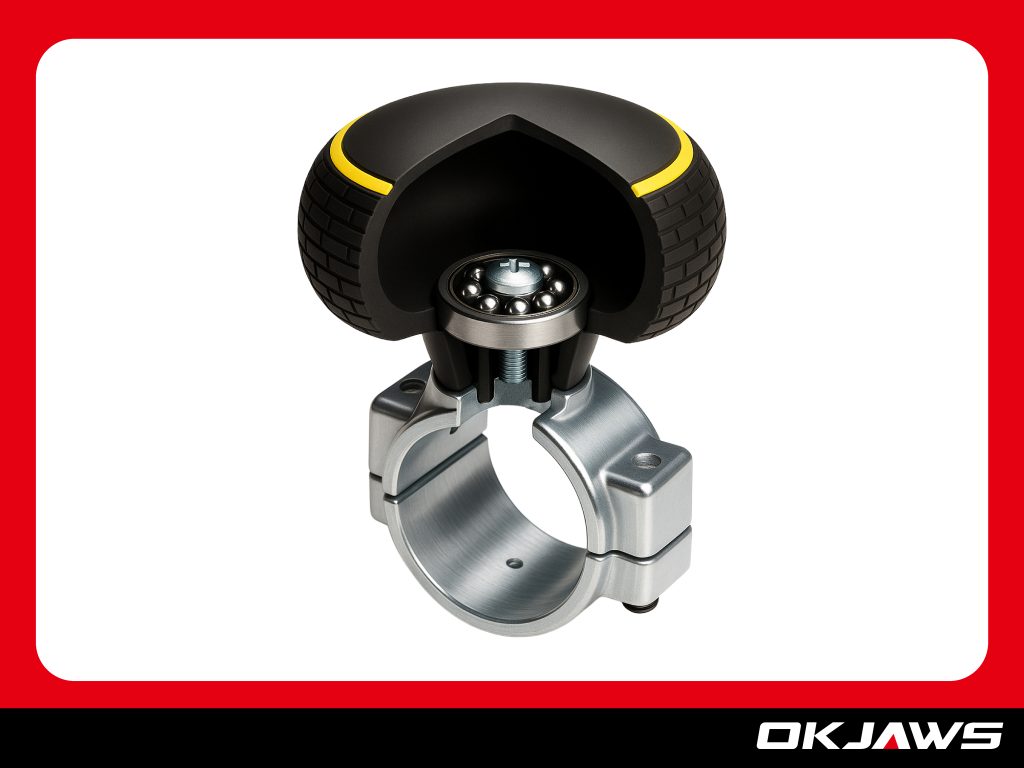
Although a precision bearing may appear simple from the outside, its internal structure is carefully engineered. At its core, the bearing consists of an inner ring and an outer ring, which create a controlled pathway for rotation. Between these rings are the rolling elements, typically steel balls or rollers, that reduce friction by allowing smooth movement rather than sliding contact.
In addition, lubrication plays a vital role. High-quality grease or oil minimizes surface friction, dissipates heat, and protects internal components from wear. However, lubrication alone is not enough. What truly defines a precision bearing is micron-level accuracy in every component. The roundness of the balls, the surface finish of the raceways, and the spacing between parts must all meet strict specifications.
Because of this precision, the bearing can rotate smoothly even under varying loads. Consequently, steering knobs equipped with precision bearings maintain consistent performance over time, rather than degrading quickly as tolerances loosen or surfaces wear.
Why Bearings Are Critical in Rotational Systems
Bearings are fundamental to any rotational control system, and steering knobs are no exception. A steering knob functions as a direct interface between the driver and the steering wheel. Every turn of the knob relies on the bearing to manage rotation smoothly while handling both radial and axial loads generated during steering.
Without a high-quality bearing, rotational motion becomes uneven. For example, poor load distribution can cause binding at certain angles or increased resistance during tight turns. However, a precision bearing evenly distributes forces across its rolling elements, ensuring motion consistency regardless of steering direction or applied force.
As a result, the bearing directly influences how the steering knob feels in use. Smooth, stable rotation enhances control and reduces physical strain, while inconsistent motion can distract the driver and reduce driving comfort. Therefore, bearings are not just supporting components—they are central to steering performance and user experience.
Summary:
This section defines what a precision bearing is by explaining its tight tolerances, internal components, and role in rotational systems. By understanding how bearing quality affects smooth rotation, load distribution, and durability, readers can clearly see why precision bearings are essential to steering performance and long-term driving comfort.
How Precision Bearings Affect Steering Knob Smoothness
Smooth Rotation Without Resistance
Precision bearings are engineered to minimize friction from the very first movement. By reducing starting torque, the steering knob rotates effortlessly without hesitation. This eliminates jerky or uneven motion, ensuring smooth and predictable control from low-speed maneuvers to continuous turns.
Consistent Performance Under Load
High-quality bearing design maintains stability even when force is applied unevenly. Whether during one-hand steering, tight turns, or parking maneuvers, the steering knob delivers consistent rotation without binding or drag, allowing confident and controlled operation in real-world driving scenarios.
Noise, Vibration, and Harshness (NVH) Reduction
Precision bearings help isolate unwanted noise and vibration during operation. The result is quiet, refined performance with reduced harshness, delivering a premium tactile feel that enhances overall driving comfort and perceived product quality.
Summary
By linking precision bearing engineering directly to rotational smoothness, this design demonstrates how internal mechanical details translate into a noticeably smoother, quieter, and more refined driving experience.
The Physics of Smooth Steering: Friction, Load & Rotation
Friction Coefficient and Surface Finish
Smooth steering begins at the contact surfaces inside the bearing. Polished raceways reduce microscopic surface irregularities, lowering the friction coefficient and allowing rotation to start and continue with minimal resistance. Controlled lubrication flow further stabilizes movement by maintaining a consistent friction profile over time, preventing stick-slip behavior.
Axial vs. Radial Load in Steering Knobs
Steering knobs experience both axial and radial forces during use, especially in tight turns and one-handed operation. Poorly designed bearings tend to bind under these mixed loads, resulting in uneven rotation and increased effort. Precision bearings, by contrast, maintain structural alignment and load distribution, ensuring stable, smooth rotation even under stress.
Rotational Balance and Human Perception
Drivers perceive smoothness almost instantly because steering is guided by muscle memory and fine motor control. Even minor inconsistencies in rotational balance can be felt through the hand. Precision bearings provide predictable, balanced rotation, improving control accuracy and reinforcing a sense of confidence and comfort during driving.
Summary
By managing friction at the surface level and maintaining stability under combined loads, precision bearings play a critical role in achieving smooth, intuitive steering. These engineering principles directly translate into improved driving comfort and a more refined user experience.
Precision Bearing vs. Standard Bearing: A Technical Comparison
Comparison Table
|
Feature |
Standard Bearing |
Precision Bearing |
|
Manufacturing Tolerance |
Loose, variable |
Micron-level controlled |
|
Steering Smoothness |
Inconsistent, uneven |
Ultra-smooth and stable |
|
Noise & Vibration |
Noticeable during use |
Minimal NVH |
|
Durability |
Short-term service life |
Long-term reliability |
|
Driving Comfort |
Average |
Premium, refined feel |
Cost vs. Performance Reality
At first glance, standard bearings may appear cost-effective, but their loose tolerances and inconsistent quality often lead to early wear, increased friction, and degraded steering performance. These failures become more pronounced under frequent use, mixed loads, or demanding driving conditions.
Precision bearings, while higher in upfront cost, deliver measurable long-term value. Their superior load handling, reduced wear, and consistent performance result in fewer replacements, lower maintenance costs, and a more reliable user experience—making them especially advantageous for fleets, OEM applications, and premium vehicle accessories.
Summary
By directly comparing standard and precision bearings, it becomes clear that investing in higher engineering quality delivers tangible benefits: smoother steering knob operation, reduced noise and vibration, improved durability, and enhanced long-term driving comfort.

Precision Bearings and Long-Term Driving Comfort
Reduced Driver Fatigue
Precision bearings minimize unnecessary resistance during steering, allowing smoother, more natural motion. By reducing wrist and shoulder strain, especially during repetitive steering actions, drivers experience less physical fatigue over time—an important factor for daily commuting and extended driving sessions.
Stability During Extended Use
Consistent rotational performance is critical during long-distance driving and in commercial vehicle applications where steering inputs are frequent and prolonged. Precision bearings maintain smooth, stable operation over extended periods, ensuring reliable performance without degradation, even under continuous load.
Psychological Comfort and Confidence
Beyond physical benefits, precision bearings contribute to psychological comfort. Predictable steering response builds driver confidence, enabling more intuitive control and reinforcing a sense of stability and safety. This consistency helps drivers feel more connected to the vehicle, especially in demanding driving environments.
Summary
By addressing both mechanical performance and human perception, precision bearings enhance long-term driving comfort on multiple levels—reducing physical fatigue, ensuring consistent operation, and fostering confidence through predictable, smooth steering response.
Why Precision Bearings Matter for Professional & Fleet Drivers
High-Frequency Steering Scenarios
Professional drivers operate in environments that demand constant steering input. Delivery vehicles, taxis, and logistics fleets rely on frequent low-speed turns, tight maneuvers, and repeated steering actions throughout the day. Precision bearings ensure smooth, responsive rotation under these high-frequency conditions, helping maintain control and comfort during continuous use.
Reliability and Maintenance Reduction
Fleet operations depend on consistency and uptime. Precision bearings are engineered for durability and stable performance, resulting in fewer replacements and reduced maintenance interruptions. Their consistent quality ensures uniform steering performance across vehicles, simplifying fleet management and improving overall operational efficiency.
Safety and Compliance Considerations
Stable steering response is critical for driver safety and regulatory compliance. Precision bearings help maintain predictable control and reduce the risk of mechanical binding or premature component failure. By enhancing reliability under load, they support safer vehicle operation in demanding commercial environments.
Summary
For professional drivers and fleet operators, precision bearing technology delivers clear advantages: smoother steering in high-use scenarios, reduced maintenance costs, and enhanced safety through reliable, consistent performance. These benefits make precision bearings a critical component in demanding, real-world driving applications.
How OK Jaws Engineers Precision Bearings for Real-World Use
Material Selection and Manufacturing Control
Precision performance begins with material choice and process control. A zinc alloy housing provides structural rigidity and dimensional stability, while high-grade bearing steel ensures consistent hardness, wear resistance, and smooth rotational characteristics. Tight manufacturing controls are applied to maintain uniform quality across production batches.
Bearing Integration Into Steering Knob Design
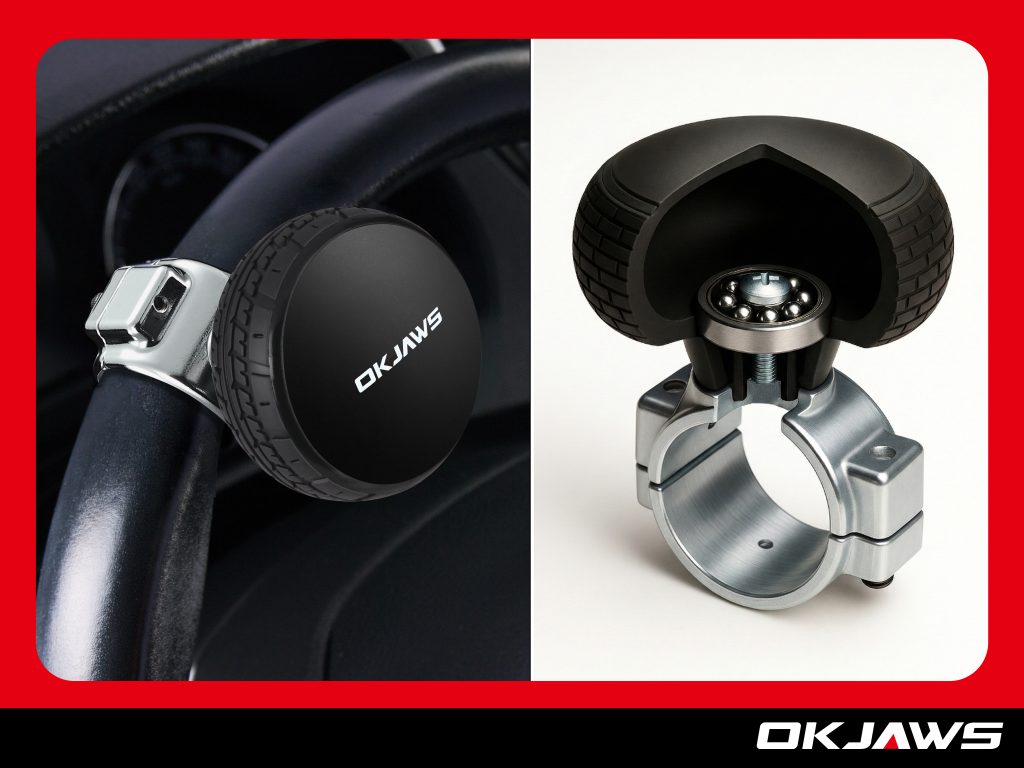
Engineering precision extends beyond the bearing itself to how it is integrated into the steering knob. Accurate alignment between the bearing, shaft, and housing minimizes eccentric rotation and uneven load distribution. A secure assembly structure prevents micro-movement under stress, preserving smooth operation during real-world driving conditions.
Quality Testing and Real-World Validation
Each design undergoes rigorous validation to ensure reliability in practical use. Load testing verifies performance under axial and radial forces, while rotation endurance testing simulates long-term operation to confirm durability, consistency, and resistance to performance degradation over time.
Summary
By applying precision bearing science through disciplined material selection, controlled manufacturing, and comprehensive testing, this engineering approach translates theoretical performance into dependable, real-world steering knob operation—reinforcing product reliability through measurable technical execution.
Common Myths About Steering Knob Smoothness
All Steering Knobs Feel the Same
While many steering knobs may look similar, their internal engineering varies significantly. Differences in bearing quality, tolerances, and assembly precision directly affect rotational consistency, resistance, and long-term performance. These factors create noticeable differences in smoothness that drivers can feel immediately.
Lubrication Alone Creates Smoothness
Lubrication plays a supporting role, but it cannot compensate for poor bearing geometry or loose tolerances. Excessive lubrication may temporarily mask friction, but without precision-machined surfaces and stable load handling, smoothness quickly degrades. True smooth operation comes from controlled friction—not lubrication alone.
Precision Bearings Are Overkill
This misconception often focuses only on initial cost rather than long-term performance. In reality, steering knobs operate under frequent mixed loads and repetitive motion. Precision bearings are engineered to handle these conditions consistently, reducing wear, maintaining smoothness, and delivering greater value over time—especially in daily or professional use.
Summary
By addressing common myths around steering knob smoothness, it becomes clear that performance is driven by engineering fundamentals. Understanding these principles enables buyers to make informed decisions based on measurable quality and long-term driving comfort, rather than surface-level assumptions.
Choosing the Right Steering Knob: What Buyers Should Look For
Bearing Specification Transparency
A high-quality steering knob should clearly state what type of bearing is used and why. Vague descriptions often hide cost-cutting compromises. Buyers should look for transparent specifications that explain bearing material, tolerance level, and intended load performance—these directly affect smoothness, durability, and long-term comfort.
Structural Stability and Mounting Design
Smooth rotation depends not only on the bearing but also on how securely it is integrated into the steering knob. Poor structural design can lead to misalignment, vibration, or uneven wear over time. A stable mounting system ensures consistent performance and prevents loosening or degradation during real-world use.
Manufacturer Experience and Testing Standards
Engineering experience matters. Manufacturers with long-term expertise and defined testing standards are more likely to deliver consistent quality. Look for evidence of load testing, endurance testing, and real-world validation rather than relying solely on visual appearance or short-term feel.
Buyer Checklist (Quick Reference)
- Clear bearing specifications (not just “smooth” or “lubricated”)
- Precision bearing design suitable for mixed axial and radial loads
- Rigid housing and stable mounting structure
- Consistent rotation without noise or vibration
- Proven durability through testing or real-world use
- Manufacturer experience and documented quality control
Summary
Choosing the right steering knob requires looking beyond surface appearance. By focusing on bearing specifications, structural stability, and manufacturer testing standards, buyers can evaluate products intelligently and prioritize precision bearing quality—the most critical factor for smooth operation, durability, and long-term driving comfort.
Frequently Asked Questions
Q1: How does a precision bearing improve steering knob smoothness?
A precision bearing reduces internal friction and maintains stable alignment during rotation. This allows the steering knob to turn smoothly and consistently, eliminating jerky motion and uneven resistance that are common with lower-quality bearings.
Q2: Does a precision bearing really affect driving comfort?
Yes. By providing smooth, predictable rotation, a precision bearing reduces wrist and shoulder strain during steering. Over time, this leads to less driver fatigue and a more comfortable, controlled driving experience—especially during frequent or extended use.
Q3: Are precision bearings necessary for commercial vehicles?
For commercial and fleet vehicles, precision bearings are highly recommended. These vehicles experience high-frequency steering and extended daily operation, where durability, consistent performance, and reduced maintenance are critical.
Q4: How long does a precision bearing steering knob last?
A precision bearing steering knob is designed for long-term use. With proper installation and normal operating conditions, it maintains smooth performance far longer than standard bearing designs, even under repeated load and continuous operation.
Summary
This FAQ section addresses common buyer questions in a clear, direct format, helping customers quickly understand how precision bearings enhance steering smoothness, comfort, and durability—making them a smart, long-term investment.
Conclusion: Precision Bearing as the Core of Steering Excellence
True steering smoothness is not defined by appearance or surface features—it is engineered from the inside out. At the core of steering knob performance lies the precision bearing, where friction control, load stability, and rotational balance work together to shape how steering feels in real driving conditions.
Precision bearings deliver more than smooth rotation. They provide durability under repeated use, consistent control during demanding maneuvers, and long-term comfort that drivers can feel immediately and appreciate over time. Whether for daily driving or professional applications, steering performance begins with what’s inside the mechanism—not what’s added on the outside.
This engineering-first approach reflects the philosophy behind OK Jaws: prioritizing mechanical integrity, validated performance, and real-world reliability over superficial claims. When steering feel, comfort, and control matter, choosing an engineering-driven solution makes all the difference.